 INBO
INBOA clinician-led diabetes-management model, powered by INBO.
INBO is being built toward a model where a health plan sponsors the technology for eligible members, while a licensed clinical team uses the physician portal to organize the population, review the relevant context, communicate with families, and make the medical decisions.
This describes where we’re taking the business — not a service already operating at scale.
How a payer-sponsored program would work.
The intended operating model — not a current deployment. INBO does not have payer contracts or covered lives under management today.
Design goals — framed as hypotheses, not proven results.
The following are the goals the model is designed around. They are not outcome claims, and INBO makes no representation of cost savings, reduced admissions, improved A1C, or ROI.
Remove the cost barrier
Eligible members receive the technology at no charge to them under the program.
One organized experience
Families get a single place for glucose, meals, insulin history, and family coordination.
A population-level workflow
The clinical team works from a prioritized view rather than isolated charts.
Surface who may warrant review
The portal is being built to help raise patients who appear to deserve attention.
Connect the care relationship
Patient, guardian, and clinician workflows are linked, with documented communication.
Make performance measurable
A structure in which agreed program metrics can be evaluated with a partner.
Not claimed: lower medical cost, fewer admissions, lower A1C, fewer severe lows, higher adherence, ROI, cost savings, or PMPM economics. These would require evidence and a real program.
The clinician remains the clinician.
INBO is designed to organize data, observations, workflow, and communication. Licensed clinicians retain responsibility for medical decisions and for the instructions they author. A language model is never the decision-maker, and INBO does not control a pump or deliver insulin.
Authored by the clinician.
Never confused.
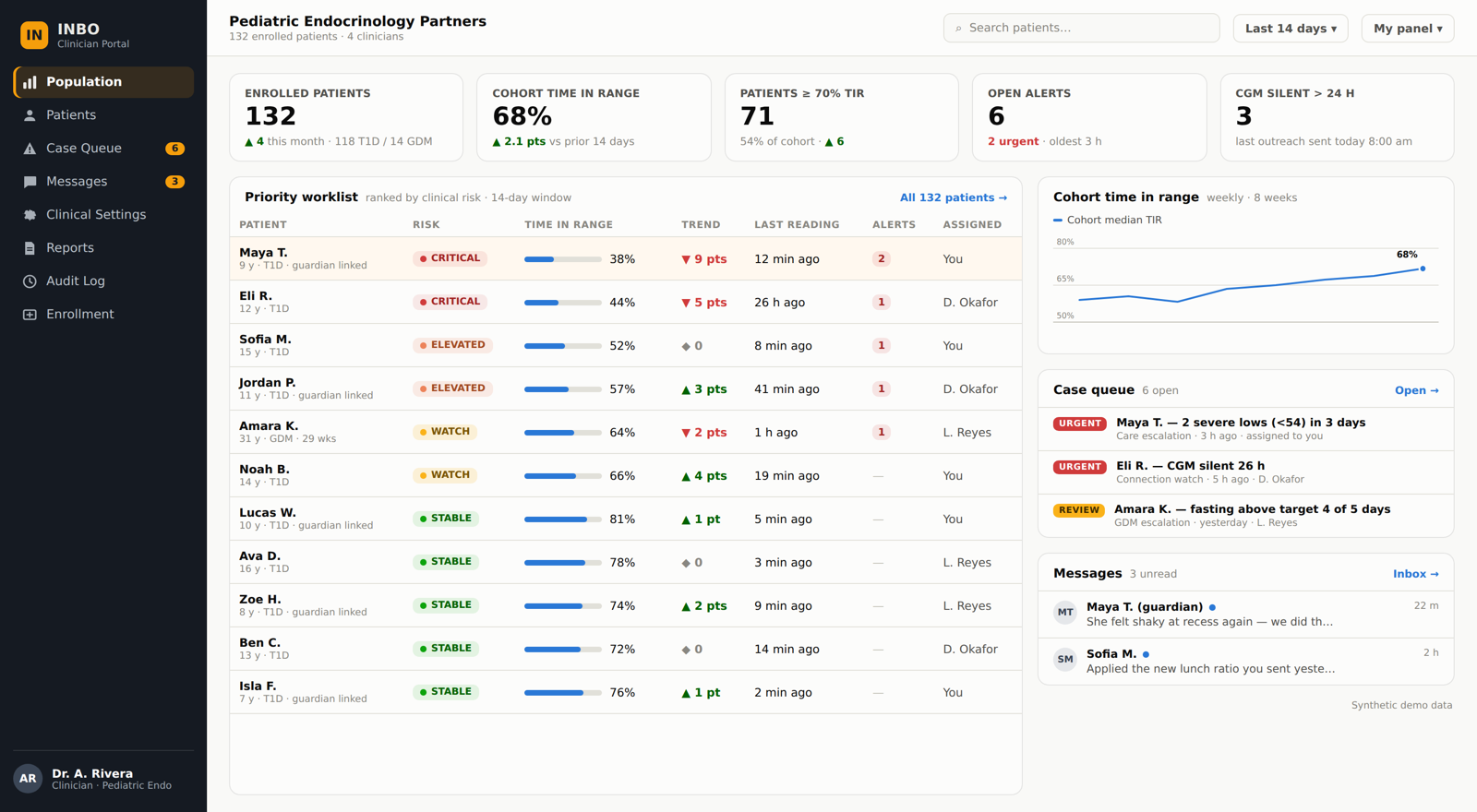
The portal is how a clinical team would run the population.
The same physician portal shown to clinicians is the operating layer for a future program: population view, clinician panels, a worklist and case concepts, patient detail, guardian relationships, a settings workflow, documented communication, and auditability.
A care model that doesn’t depend on the dose engine.
The near-term clinician-led care model does not have to depend on the private dose-calculation function. The public app and the portal support data organization, patient and guardian workflow, documentation, communication, reporting, and clinician review — while higher-risk software functions follow the appropriate regulatory path in parallel.
INBO does not claim that hiring licensed clinicians, having a physician partner, or providing the app to members at no charge removes regulatory requirements for any software function. The website does not classify specific functions as exempt. Regulatory work proceeds in parallel; it is not a workaround.
Built by someone who has scaled healthcare software before.
INBO’s founder previously founded, led, and sold two healthcare-software companies focused on digital medical records and workflow management, with 460 employees combined — and is now the parent building the diabetes tool his own family needed.
Let’s make the opportunity legible together.
The product foundation is real; the care-delivery business is the model we’re building. It is early enough for a payer or clinical partner to help shape how the program works — and there is something real to evaluate today.
No pricing, PMPM economics, or savings figures are published here — those come with a real program and verified data.